Friday, July 8, 2011

July 10th 2011: Sunday Gospel Reflection

Matt 13:1-23

I was away from home housesitting for a family for two weeks and the plant in my room at home went unattended and un-watered the whole time! I forgot about it, did not tend to it, and it is dying. What else should I have expected?

Jesus desperately sought time for prayer and reflection to cultivate his inner life. We all know that Jesus went to the desert for 40 days but throughout His life He regularly went away and found time to be alone with His Father and to pray. In today’s Gospel he goes to the Sea to reflect, then when people crowd around Him, He gets in a boat to get some space; this is a model that we should follow.

-How much time in a given week do I spend on prayer and meditation? 
-Do I go to Mass once a week?
-Do I spend time in the morning, midday, or evening reflecting on the day and God’s presence (or sometimes lack thereof!) in my day?

It is not always easy amid a busy life (even in the Summer!) to slow down and check-in with our inner life, this is why it can be so valuable to get into a routine of incorporating prayer into life: brushing teeth, reflection book next to bed, a prayer to say when you get in the car or public transportation, praying before meals. These moments allow us to reclaim throughout a day our identity: Beloved of God.

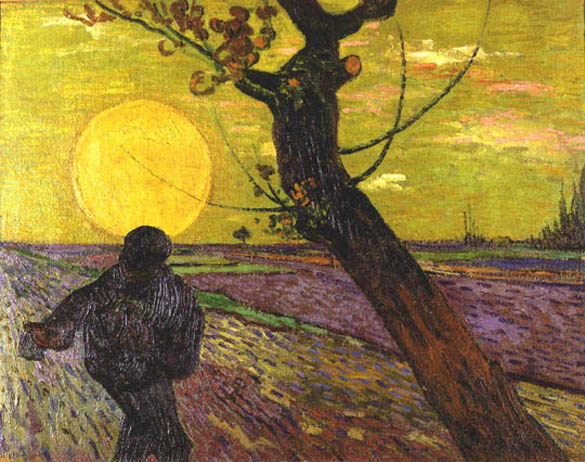
The parable that Jesus tells the crowds and teaches His disciples depends upon cultivating this inner life: the parable of the sower. Some of the seed falls on rocky ground, others amid thorns, but some falls on rich soil that grows into an abundant harvest. If we follow the example of Jesus to take time each day to tend the soil of our souls, our inner life, then the seed of God’s love will be able to take root in us and our lives will bear fruit.

If we do not water or tend the soil of our hearts, our inner life, how can we expect it to be healthy, bear fruit, or even stay alive?

“Whoever has ears ought to hear...but blessed are your eyes, because they see,
and your ears, because they hear.”
Sunday, July 3, 2011

July 3rd, 2011: Sunday Gospel Reflection II


When our hearts are as open and trusting as little children to God’s love and truth 
we will find the peace and rest that we desperately long for.

Questions for Reflection and Discussion
-When in my day do I slow down to talk and check in with God?
-How much time to I spend in quiet reflection each day?
-Do I trust that the teachings and message of the Scriptures and the Church are helping me be a better person or do I assume that they are wrong if I think differently?
-If I disagree with something in the Scriptures or that the Church teaches do I try to learn more to understand why it is taught?
-Seeing God as my Father do I act like an attentive, patient, and obedient child?
-What is a part of my life that I am not willing to let God be a part of?

Saturday, July 2, 2011

July 3rd, 2011: Sunday Gospel Reflection I

Matthew 11:25-30

When our hearts are as open and trusting as little children to God’s love and truth 
we will find the peace and rest that we desperately long for.

In today’s Gospel Jesus uses the metaphor of a yoke (not the egg) to teach us about how we are to live our lives. A yoke is a piece of wood that is placed around the neck and shoulders of two animals walking side by side pulling something behind them (carriage, tilling equipment, etc.). The yoke keeps the animals moving at the same pace so that they pull what is behind them evenly.

In this analogy Jesus is walking with us and promises that if we allow God’s yoke to be placed upon us that it will help us to walk happily step by step with Jesus.  The yoke can represent listening to God’s voice in prayer and following God’s laws given through Jesus and the Church. Sometimes placing the yoke of God’s message around us and asking us to walk at God’s pace is something that can seem violent or constrictive but Jesus promises us that the God who made us knows what will make us most happy and that His yoke is not heavy, painful or burdensome, but light and easy.

In today’s Gospel Jesus tells us that the “wise and the learned” have not heard God’s message but that God has “revealed them to little ones”; we are called to be as trusting and open as a young child to God the Father even though sometimes we rebel like spoiled children when we are told that someone knows what is better for us. When we slow down enough and allow Jesus to walk with us, allowing Jesus to set the pace, we will be happier and more full of peace and joy then we could ever be without Him.

Why do we think that setting our own varied pace or making our own decisions without asking God will make us happier than walking pace by pace with Him who made us and loves us more than we could ever know?

Jesus I trust in you.

Monday, June 27, 2011

Pope Goes Hybrid!

Little is known about Pope Benedict XVI's reflections on ecology and care for God's creation but the possibility of a first-of-it's-kind new hybrid Pope-mobile makes some news!

Friday, June 24, 2011

June 26th, 2011: Sunday Gospel Reflection

John 6:51-58


In today’s Gospel we read from Chapter 6 the Gospel of John, called the Bread of Life Discourse (I would recommend reading the whole passage from John 6:22-71). In this story a crowd follows Jesus in boats across the Sea of Galilee to track Him down.  He had recently performed the miracle of the feeding of the 5,000 and many were amazed and wanted to listen to Him and see what He was going to do next. When they track Him down Jesus’ message is that the real miracle is not multiplying physical food but feeding people spiritually, “do not work for the food that perishes, but for the food that endures for eternal life, which the Son of Man will give you.” The crowd did not understand and asked for another miracle from Jesus; they didn’t get it!

When Jesus continued to explain that He Himself was the bread, the food that endures, “my flesh is true food and my blood is true drink” the crowd got upset with Him and many went away disappointed because, “this teaching is hard to accept”. Instead of calling them back and clarifying that what He meant was figurative Jesus stayed on message and turned to ask His disciples if they would leave Him too. By God’s grace they did not leave Jesus (though they would not fully understand what Jesus meant until later).

At the Last Supper, the night before Jesus was put to death, Jesus instituted a ritual action to make Himself present with us even after His death and resurrection. “Jesus took a loaf of bread, and after blessing it he broke it, gave it to the disciples, and said, ‘Take, eat; this is my body.’”. Jesus’ disciples did what Jesus told them to “do this in remembrance of me”. From the earliest Christian writings we have accounts where the followers of Jesus would gather on Sundays and break bread; they celebrated Eucharist so that they may be strengthened by the Body and Blood of Jesus which St. Ignatius of Antioch (who was born less than 20 years after Jesus died) called the “medicine of immortality”. Through this ritual action handed down from Jesus through the Apostles, other Bishops, and priests for over two thousand years we are able to continue to celebrate the Eucharist. We receive the Eucharist every Sunday to be renewed and strengthened, to become what we already are, both individually and as a community: the Body of Christ. It is not always easy to see Jesus’ presence with our eyes but we take Jesus at His word that this is my body which was given up for us on the cross and continues to be given for us each Sunday.

Jesus cares intimately about you, wants to be near to you and has given us a way to nourish our bodies and souls. Thank you Jesus for the gift of yourself present in the Eucharist. I believe in You.

Gospel in Action
-Sometimes it is difficult to believe in something we cannot see. In these moments we can pray the prayer of St. Thomas (who had trouble believing in the Resurrection): “Lord, I believe, help my unbelief”

Sunday, June 19, 2011

Happy Father's Day!


It is important that we celebrate Fathers' Day well! Dads are important and sadly their role in many people's lives is underdeveloped or under-appreciated.

Take some time to day to show love and prayer for those fathers in your life: parents, priests, grandparents, and those who have gone before us that have played a role in fathering us. As Christians we can ask for the prayers of the father of Jesus in a special way to pray for our own fathers.

When I was in college there was this twice than life-size statue of Saint Joseph that said "Joseph, father of Jesus, be our father". I think this is an important prayer and an idea one that is often overlooked: as we are brothers and sisters of Jesus we can also ask Joseph to be our father-figure by asking for his prayer and support. He went through the same struggles and joys that all fathers experience and he is our model for what it means to be a holy father; we can learn so much from a man who never says a word in the Gospels!

And to my dad who takes the time to read my random ministerial musings...thank you dad for being an amazing role-model and father and continuing to teach me so much in both word and actions. I love you.

Friday, June 17, 2011

June 19th, 2011: Trinity Sunday Gospel Reflection

   
The Holy Trinity

This Sunday is another big day (feast day) for the Catholic Church throughout the world. Today we celebrate The Most Holy Trinity, God who has revealed Himself as Father, Son and Spirit!

We believe that the mystery of the Most Holy Trinity is the central mystery of Christian faith and life (CCC 234); this is the most core belief for Christians. For thousands of years Christians have struggled to understand how we can only believe in one God if we talk about God the Father, God the Son, and God the Holy Spirit. There is no easy or complete answer to this question but here are a few quick thoughts to better understand the Trinity:

1. God is transcendent. He is infinite and He created us. He is a mystery that we can always dive deeper into, a person we can always learn more about. It is impossible to try to fully ‘make sense’ of or ‘get’ God (this is a problem that science cannot explain…knowing God requires faith and trust). “As high as the heavens are above the earth, so high are my ways above your ways and my thoughts above your thoughts.” (Isaiah 55:9)

2. We can only know God through His effects, the ways that He has revealed Himself to us. From the Traditions in the Old Testament, New Testament, and continued through our Church today God has chosen to reveal Himself to us as a Father, as Jesus the Son, and as the Spirit.

3. God is active and dynamic love (self-gift). St. Augustine, writing in the 5th century, said helping to explain the Trinity that “wherever there is love, there is trinity: a lover, a beloved, and a fountain of love”. Love is not a static process but is constantly active and at work. Love also is procreative, it can’t help but be shared and overflow. The love of the Father for the Son is manifest as the Spirit. The inner dynamic relationship of the three persons of the Trinity is so active and powerful that it overflows into the world—this is the act of creation. God’s love continues to be poured forth. Our mission as Christians is to be open to allow God’s life overflowing, to allow His Love to fill us, and to share that cup with those around us. When we do this we enter into the same dynamic rhythm, movement or dance that is God’s life.

Questions for Reflection and Discussion 
-How open am I to allow God’s presence to fill me?
-What do I need to get rid of in my heart to allow more space for God?

This Week
- Make the Sign of the Cross the next time you pray! Every time we mark ourselves with the ‘sign of the cross’ we are saying a prayer and making a commitment to faith. When we sign ourselves in the name of the one God, Father, Son and Holy Spirit we affirm our belief in the Trinity and that the Divine Life of God dwells within us!