Monday, February 28, 2011

Gratitude allows us to see miracles (God's activity) around us

Chilean Miners Visit Holy Land to Thank God for Being Rescued

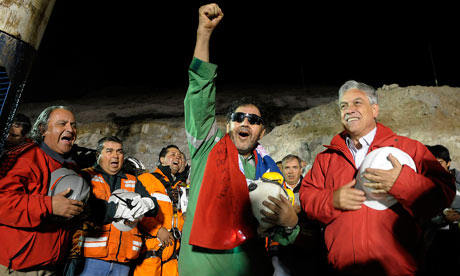
JERUSALEM (CNS) -- Despite the overwhelming media attention they received and heated debate over the purpose of their visit, 25 Chilean miners who arrived in Israel in late February said theirs was a visit of thanksgiving. "We want to thank God for all that he did for us. Our faith and hope were fundamental for our survival," said Mario Gomez, the oldest of the 33 miners trapped for more than two months underground while dramatic rescue efforts attracted worldwide attention. "It was a miracle," Gomez said of his rescue; he was 63 at the time. "There is one being who could achieve that, and that is God. He gave us a second life. When we exited the capsule, we returned to being ourselves." The miners said they were eager to see the Church of the Holy Sepulcher, the Via Dolorosa -- the traditional route of Jesus' Way of the Cross -- and the Western Wall among other religious and historic sites. Richard Villarroel and his wife, Dana Castro, brought along their 4-month-old-son, Richard, born six days after the rescue. "We prayed every day. I lost count of the numbers of Hail Marys and Our Fathers we said," said Villarroel, who carried his son in a baby carrier on his chest. Young Richard was covered with a Jewish prayer shawl to protect him from the sun as they walked on the Via Dolorosa surrounded by cameras. Maintaining a vigil above ground during the rescue, Castro said she was strengthened by the power of the Holy Spirit, whose presence she felt. "Now I want to give thanks to God and his son who was here. I want to have some quiet and talk to them. Now we are all three here," she said. (www.catholicnews.com)

...perhaps we could go out of our way to be grateful for something today that we regularly take for granted.


Thursday, February 24, 2011

Thursday Inspiration - Wait for the LORD

Wait for the LORD; be strong, and let your heart take courage; wait for the LORD! - Psalm 27: 14

I don’t think waiting for the Lord is quite the same thing as waiting in line at the grocery store. God doesn’t somehow pay less attention to us because we’re behind someone else in a queue. No, we believe God loves us all, all the time. Waiting for the Lord engages a different part of who we are, a part that might not come alive as we wait in a line: our hearts. When we wait, we take a pause to pray and allow God to be God. Wait for the Lord’s love – choose not to let that one person at work get to you. Wait for the Lord’s courage – choose to make that tough phone call. Wait for the Lord’s strength – that difficult decision won’t be any less difficult, but God is there. All requires heart-strength; all requires God’s grace. Be strong and wait.

Wednesday, February 23, 2011

February 27, 2011: Gospel Reflection II


Reflection/Discussion Questions:
-Do I believe that God is going to take care of me no matter what? 
-What experiences have reinforced that belief for me?
-How can I learn to trust God more this week?
-What are some of the things that I worry about the most?
-How is God asking me to let Him be in control of that worry?

Respond:
1a.This week find something in nature that shows the beauty of God’s creation . Allow that beauty to be a reminder of God’s power and love for you.
1b.This week find a quality in yourself that reminds you that you are made and loved by God. 

2. When you take some time for prayer this week allow the palms of your hands to be open facing upward to God imitating your openness to allowing God to be in control of those things that we would prefer to control.

Tuesday, February 22, 2011

February 27, 2011: Gospel Reflection I


For this week’s Gospel I imagine Jesus standing and preaching in one of these Window’s computer backgrounds to show us about God’s power and love for us. The point is simple yet complex for our hearts. God made everything. God is in control. Somehow in nature flowers and grass continue to bloom and grow each year. God knows, loves and cares for everything in creation, including us.

The pragmatist in each of us rejects this week’s Gospel: Is God going to pay my rent/mortgage this month? Really? Perhaps the skeptic in us points to the millions who die of hunger each day and how much some sort of ‘God’ is taking care of them. The point to the Gospel is not that God is going to do everything for us but that God knows us, loves us, and cares for us.

For the pragmatist: No, God will not pay your bills this month, but we are invited to recognize God’s place as our creator and that as we work to take care of ourselves and others to remember that all the gifts we have been given come from God.

For the skeptic: God gave us free will to enable us to love Him and others. God calls us to participate in the ongoing creation of the world by being his hands and feet to take care of others. St. Teresa of Avila said: “Christ has no body now but yours. No hands, no feet on earth but yours. Yours are the eyes with which he looks compassion on this world.”

The danger for both the pragmatist and the skeptic in all of us is that our actions and ideas become the center of the universe; we make ourselves into the gods of the world (an added pressure we really don’t need!) which only distances us from being able to allow God to be present and in control through every worry and joy that comes our way.

Sunday, February 20, 2011

The Nonpossessive Life

From the wisdom of Henri Nouwen:

To be able to enjoy fully the many good things the world has to offer, we must be detached from them. To be detached does not mean to be indifferent or uninterested. It means to be nonpossessive. Life is a gift to be grateful for and not a property to cling to.

A nonpossessive life is a free life. But such freedom is only possible when we have a deep sense of belonging. To whom then do we belong? We belong to God, and the God to whom we belong has sent us into the world to proclaim in his Name that all of creation is created in and by love and calls us to gratitude and joy. That is what the "detached" life is all about. It is a life in which we are free to offer praise and thanksgiving.

This reflection is taken from Henri J.M. Nouwen's Bread for the Journey.  
Visit HenriNouwen.org for more inspiration!

Friday, February 18, 2011

How do I love those I don't even like?

What is the path to loving others? Loving even those we don't like?

From the 1st encyclical of Pope Benedict XVI entitled God is Love (Deus Caritas Est):

"Love of neighbor is thus shown to be possible in the way proclaimed by the Bible, by Jesus. It consists in the very fact that, in God and with God, I love even the person whom I do not like or even know. This can only take place on the basis of an intimate encounter with God, an encounter which has become a communion of will, even affecting my feelings. Then I learn to look on this other person not simply with my eyes and my feelings, but from the perspective of Jesus Christ. His friend is my friend. 

 Going beyond exterior appearances, I perceive in others an interior desire for a sign of love, of concern. This I can offer them not only through the organizations intended for such purposes, accepting it perhaps as a political necessity. Seeing with the eyes of Christ, I can give to others much more than their outward necessities; I can give them the look of love which they crave. Here we see the necessary interplay between love of God and love of neighbor which the First Letter of John speaks of with such insistence...

Only my readiness to encounter my neighbor and to show him love makes me sensitive to God as well. Only if I serve my neighbor can my eyes be opened to what God does for me and how much he loves me...

Love of God and love of neighbor are thus inseparable, they form a single commandment. But both live from the love of God who has loved us first. No longer is it a question, then, of a “commandment” imposed from without and calling for the impossible, but rather of a freely-bestowed experience of love from within, a love which by its very nature must then be shared with others. Love grows through love. Love is “divine” because it comes from God and unites us to God; through this unifying process it makes us a “we” which transcends our divisions and makes us one, until in the end God is “all in all” (1 Cor 15:28)." (Pope Benedict XVI, Deus Caritas Est (God is Love), Section 18)

Thursday, February 17, 2011

February 20, 2011: Gospel Reflection II

Matthew 5:38-48
Reflection Questions:
-Do you believe that God loves you no matter what you do? What experiences lead you to that conclusion?
-Who are people in your life that you have a hard time loving, forgiving or who you view as an enemy?
-How do you feel God is inviting you to respond to those particular people?
-When confronted with a situation where you are tempted to act or respond out of anger or hurt what can you practically do to avoid those temptations and bring God’s love instead?

Respond:
-This week: pray for someone who you have a hard time loving, forgiving or view as an enemy. Don’t pray that they may change/be fixed, but that God may bless them and give them good things this week and always.
-Go out of your way to lavish love on someone who you would rather not
-Learn more about the life and example of St. Therese or The Forgiveness Project (see below)

 The Forgiveness Project

The only way to loving is through forgiving
                                                         forgiving self
                                                             forgiving others